
St Anne's School
Reception
Foundation Stage Curriculum
At St. Anne’s School, we are incredibly lucky that alongside their classrooms the Foundation Stage children have access to additional shared space inside the building as well as their own dedicated outdoor space. This enables us to provide outdoor provision throughout the day for the children which we believe to be important.
Children in Reception at St. Anne’s School will:
- Extend their learning through The Characteristics of Effective Learning.
- Receive a balance of self-initiated tasks and teacher led activities.
- Challenge themselves in a variety of situations.
- Be encouraged to be independent in their learning, taking their learning on with an appropriate level of intervention.
- Be taught phonics to support early reading and early writing.
- Be encouraged to write for a variety of audiences and purposes.
- Develop their use of language.
- Be encouraged to think Mathematically in a variety of situations.
- Develop their personal, social and emotional skills.
Early Years Foundation Stage Reception Class: Intent, Implementation and Impact Statement
Intent
At St. Anne’s we aim to provide motivating first-hand experiences whilst encouraging children to develop resilience, ambition and a lifelong love of learning.
We aim to build on the knowledge and skills children already have when they arrive and are actively developing relationships with feeder settings. We recognise that all children are unique, celebrating and welcoming differences within our school community. Therefore, much of our curriculum is child centred following the interests and fascinations of the children in the current year group. We are passionate about children leading and engrossing themselves in their learning. We aim to embed a love of learning in the children and provide activities to promote the behaviours described in the “characteristics of effective learning”.
We aim to:
- Provide a curriculum that offers children a wide range of opportunities ensuring that we do not expect children to aspire to things they have never encountered. We will work on broadening their experiences providing opportunities to try new things and encouraging them to relish a new challenge.
- Provide high expectations encouraging them to develop perseverance and self-belief so that they can problem solve and achieve far more than they expected
- Provide a learning environment that helps children achieve their potential and support those who need additional help in order to maximise their chances of achieving the Early Learning Goals.
- Provide children opportunities to develop their sense of wellbeing and ability to regulate their feelings so that they feel confident in our community and are equipped with all the tools they need to transition to Year 1 effectively.
- Develop the skills and expertise of staff working in EYFS through regular and comprehensive professional development either run by the EYFS team in Guernsey or attending courses run by other providers.
Implementation
Our curriculum is rooted in the EYFS framework (2017) which delineates the Characteristics of Effective Learning, the 7 areas of learning which should be covered and the 17 aspects contained within them. We base our work on the 4 overriding principles of “the Unique Child, Positive Relationships and Enabling Environments leading towards Learning and Development”. Through our knowledge of each child and formative assessments the EYFS team plan exciting and engaging activities that will move the children’s learning forward. This may involve following a class theme where we take advantage of cross curricular links in order to combine transferable skills and develop a wide-ranging vocabulary and knowledge which underpins the children’s learning. This may also include following individual children’s interests and making the most of those focused moments where the teaching and learning can be maximised in a one to one way with teacher and child.
Our practice is influenced by the Reggio Emilia approach to early education and our classroom and outdoor areas are established as workshop areas in which the children have a rich variety of open ended materials and loose parts to access. We aim to enable each child to demonstrate their learning and understanding through the “100 languages of children” as explained by Loris Malaguzzi. Each year creates its own unique blend of whole class, guided, adult directed play and child-initiated play activities dependant on the nature and needs of the class of individuals. We look forward at the start of a year to see where the class will lead us.
Children in EYFS learn by playing and exploring, being active and thinking critically and creatively and this takes place both indoors and in our outdoor area. Our outdoor area is open all year round and in all but the most challenging weather conditions. Children make their own decisions about where they learn best and teachers ensure that there are opportunities for all areas of learning both inside and outside.
Alongside child led learning we maintain a balance with teacher lead daily sessions of direct teaching for example maths, phonics, music, PE. The school follows the Read, Write, Inc phonic programme, using a wide range of physical resources to support this. Every child has access to phonics sessions with extra opportunities for those who find this area of learning more difficult. We teach non cursive handwriting over the year.
We provide effective and focused sessions for those children who are finding learning challenging and are not on track to meet expectations at the end of the year. This will be provided in an inclusive way and support from parents is also enlisted at an early stage to ensure that the children have every chance to achieve the Early Learning Goals.
The EYFS team collect evidence of children’s learning through work completed in their learning journey, observations, photos and videos which are shared with parents using the Evidence for Learning online system. This means that parents can engage with children regularly about their learning and can contribute to the knowledge we have of the child in school. Parents are very positive in their response to the electronic learning journey and love to use “wow moments” to record the milestones children make at home during the year.
We provide children with opportunities that they may not have experienced before or that enhance their learning in school. We may go on visits to support this for example a trip to the vets or arranging for a local wildlife expert to come into school to talk to children about their job during a focus on beaches. We ensure that all of our visits are learning related and will provide the spark for further immersion in a theme or project.
By the end of the year we provide opportunities for children to increase their independence in recording their work as appropriate to ensure they are well prepared for the move to Year 1. We also ensure that the pedagogy in Year 1 reflects the independent learning skills children have gained in Year R working together as a team to develop expertise and confidence in all teaching staff. We do this through team meetings where reflections on practice are made, evaluated and decisions about the best way to move forward to enhance children’s learning.
The team in Year R work together to ensure that children are surrounded by a kind, caring and happy environment which helps them develop the firm foundations in their journey through school. It is a positive place to be where resilience, perseverance and successes are celebrated and every child feels valued and respected.
Impact
The impact of the EYFS curriculum is reflected in having well rounded, happy and confident children transitioning into Year 1. Our children are often role models for others in school.
We measure progress and children’s learning across the year through formative and summative assessment which are based on the teacher’s knowledge of the child, their output, photographs or videos and the Evidence for Learning electronic learning journey. We aim to meet or exceed Bailiwick of Guernsey data for children achieving Good Level of Development.
The judgements of our school are moderated with other schools in the Bailiwick and the EYFS Lead is a moderator in other schools. This means judgements are secure and consistent with Bailiwick guidelines.
The Early Years provision features in the School Development Plan and has its own plan for development each year. This is monitored and evaluated by the EYFS Lead and the Headteacher.


Early Years Newsletter Spring 2025
Moving into Reception Class from Little Acorns
Development Matters
Preparing your child for Reception
Learning to talk - what to expect at 4 years old
Eat Healthy
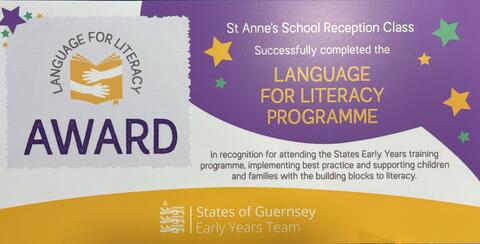
Language for Literacy Programme Award


Eat Them To Defeat Them
Reception children have received a pack with stickers, a chart and information for parents. Reception Class received a box of vegetables from the Health Improvement Commission in Guernsey and have made delicious kebabs and soups so far...


